How long do braces actually take?

You look in the mirror, see crowded teeth, gaps, or a bite that doesn't seem right, and the natural question immediately arises: how long do braces take? For most patients, the honest answer is not "very quickly," but it's also not as long as they fear. The duration of orthodontic treatment depends on the problem to be corrected, the type of braces chosen, and how well the doctor's plan is followed.
Many adults put off getting braces precisely because they imagine years of discomfort and frequent check-ups. In reality, the treatment has clear stages, results appear progressively, and the time invested brings real benefits for chewing, oral hygiene, and aesthetics. When the plan is made correctly and monitoring is consistent, every month of treatment has a precise purpose.
How long do braces take in the most common cases
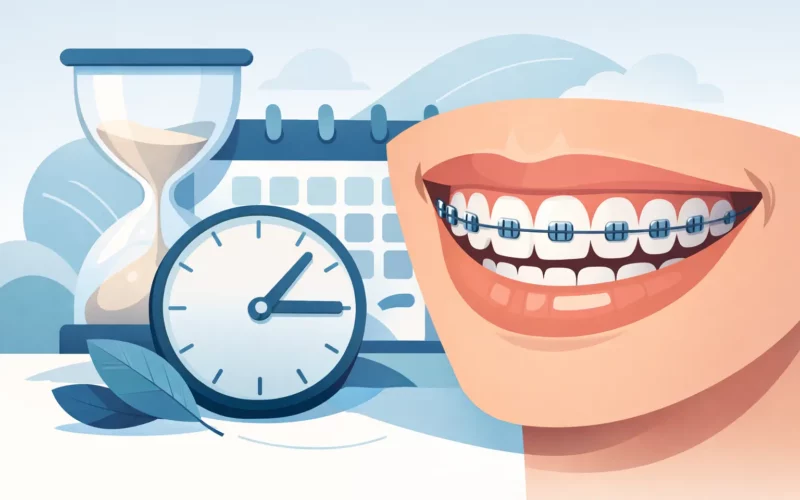
On average, braces are worn for between 12 and 24 months. This is the timeframe we see most often in mild to moderate cases. If we are talking about more complex issues, such as severe crowding, deep bite, crossbite, or large gaps between teeth, the treatment can exceed 24 months.
There are also situations where the duration is shorter, sometimes around 6 to 12 months. This happens when the necessary movements are limited and the patient comes in on time for adjustments, follows instructions, and there are no complications. On the other hand, an apparently simple plan can be prolonged if check-ups are missed or if hygiene issues, cavities, or gum inflammation occur.
That is why the right question is not just how long do braces take, but also what exactly needs to be corrected. The duration is not determined "by eye," but after a consultation, investigations, and a bite analysis.
What influences treatment duration
The first factor is the complexity of the case. If the teeth are only slightly rotated or there are small gaps, their movement can be done relatively quickly. If the jaws do not close correctly or there are impacted teeth, lack of space, or old dental migration, the treatment becomes more extensive.
The second factor is age. Teeth can be straightened in adults too, and orthodontics is not reserved for teenagers. However, in young patients, certain corrections can progress faster because the structures are still developing. In adults, the plan may require more finesse and patience, especially when there are dental restorations, gum recession, or old tooth loss.
The type of braces also matters, but not in the way many imagine. Fixed metal braces are very efficient and offer good control over movements. Ceramic braces are more discreet, but the treatment duration does not differ radically just because the material is different. Clear aligners can be an excellent option in certain cases, but their success depends heavily on consistent wear. If they are not worn for the recommended number of hours per day, the treatment is prolonged.
There is another essential factor, often underestimated: patient cooperation. Elastics worn correctly, good hygiene, keeping appointments, and avoiding foods that can detach brackets make a real difference. Well-chosen braces cannot compensate for a lack of consistency.
How long do braces take until you see the first results
In many cases, the first changes can be observed after 6 to 10 weeks. A rotated tooth begins to align, a gap seems to shrink, and the smile starts to look more orderly. These changes are encouraging, but they do not mean the treatment is near the end.
The visible part is just one stage. Teeth must not only be aligned but also positioned correctly for function, so that the bite is stable. Often, patients say that after a few months the smile already looks much better and wonder why the treatment needs to continue. The answer is simple: quick aesthetics are not the same thing as a complete and lasting result.
In a modern clinic, planning is all about balancing aesthetics and function. It is not enough for teeth to simply look straight. They must work together correctly, and that requires time and control.
Why treatment doesn't happen overnight
Orthodontic treatment begins with a consultation and diagnostic tests. This is where the actual problem, the treatment direction, and the estimated duration are determined. This estimate is serious, but it remains an estimate nonetheless. Every patient's biology reacts differently.
Next is the active phase, where teeth are gradually moved. Periodic adjustments are not just formalities. At each check-up, the doctor monitors progress, adjusts forces, and decides on the next steps. If a bracket comes off or a patient misses an appointment, the pace changes.
Finally, there is the retention stage. Many people think they are "done" at this point and stop being careful. In reality, retention is the reason the results last. After the braces are removed, teeth have a natural tendency to shift. That is why retainers or fixed retainers, worn according to the doctor's instructions, are recommended.
Why treatment sometimes takes longer than initially estimated
There are several common reasons. One is missing scheduled appointments. Even a delay of a few weeks, if repeated, can add months to the final timeline. Another reason is poor hygiene. If gum inflammation occurs, the doctor may need to slow down or temporarily pause certain stages.
Small accidents matter, too. A loose bracket, a displaced wire, or not wearing elastics correctly may not seem dramatic at the time, but they affect the direction of tooth movement. Likewise, if the patient needs parallel dental treatments, such as fillings, extractions, or restorations, the orthodontic plan sometimes needs to be adjusted.
There are also situations where teeth move slower than average. This is not a mistake, but an individual biological reaction. That is precisely why promises like "guaranteed to be done in X months" should be viewed with caution. A good plan is a realistic one, not one that looks impressive only on paper.
Does orthodontic treatment take longer for adults?
Not always, but it can often take a little longer than for adolescents. For adults, treatment is performed on a fully developed dentition, sometimes involving crowns, implants, old gaps, or dental wear. This does not mean the results are inferior, but rather that the planning must be more meticulous.
The good news is that adult patients are generally more disciplined. They keep their appointments, follow instructions, and have clear motivation. This can compensate for many of the challenges related to age. That is why there are numerous cases where adults achieve excellent results within a timeframe very close to the initial estimate.
If you are considering orthodontic treatment for aesthetic reasons alone, it is worth knowing that the benefits go beyond appearance. Aligned teeth are easier to clean, the risk of uneven wear decreases, and pressure on certain areas of the jaw joint can be reduced.
How to realistically shorten treatment time
There are no miracle shortcuts, but there are habits that help. The best method is to follow your doctor's recommendations exactly. Come to your check-ups on time, wear your elastics if they were prescribed, and notify the office immediately if a problem with your appliance arises.
Excellent oral hygiene makes the difference between a smooth treatment process and one interrupted by complications. Careful brushing, proper cleaning around brackets, and regular check-ups keep tissues healthy and allow the planned stages to continue as scheduled.
Diet also plays a role. Very hard or sticky foods can damage your braces and delay progress. It’s not about extreme restrictions, but rather care and consistency. In orthodontics, great results rarely come from grand gestures and almost always from steady discipline.
What to keep in mind before you start
If you want a short answer to how long braces take, the most common timeframe is between 12 and 24 months. However, if you want the right answer for your specific case, you need a thorough orthodontic consultation. That is where we determine whether we are looking at a simple correction or a complex, multi-stage treatment.
At Art Dental Studio, the right approach means careful evaluation, modern technology, and a plan tailored to your goals, not rushed promises. A beautiful smile is built properly when health and aesthetics go hand in hand. If you have been thinking for a while about braces, the best time to find out the actual duration is not "later," but during a consultation where you get a clear answer for yourself. Book an appointment and take the first step toward a result that is worth the wait.