What exactly does cosmetic dentistry mean?

A beautiful smile is about more than just whiter teeth. When patients ask what dental aesthetics means, they usually want to know something more concrete: what treatments are available, whether the result looks natural, how long it lasts, and if it is worth the investment. The simple answer is that dental aesthetics means improving the appearance of your smile without compromising health, functionality, or facial proportions.
This matters more than it might seem at first glance. An aesthetic smile is not just "picture-perfect," but also balanced, comfortable, and tailored to each patient. Teeth that are too white, too large, or too uniform can look unnatural. In contrast, well-executed dental aesthetics corrects imperfections while maintaining a natural look.
What dental aesthetics means in practice
In practice, dental aesthetics is a branch of dentistry that aims to improve the shape, color, position, and harmony of your teeth. It is not just about "whitening," but about a range of solutions that can transform your smile in a subtle or dramatic way, depending on the patient's needs.
A dental aesthetics plan may include professional whitening, dental veneers, all-ceramic dental crowns, orthodontic treatments for alignment, replacing old, unsightly dental work, or full-mouth rehabilitation when the teeth are affected both aesthetically and functionally. The choice of treatment is based not on trends, but on tooth structure, bite, gum health, and the desired outcome.
That is why the first step is a proper evaluation. Not every patient needs veneers, and not every problem is solved by whitening. Sometimes, orthodontic correction radically changes the appearance of a smile. Other times, a well-crafted crown or replacing old fillings can yield a much better result than an extensive procedure.
What problems can dental aesthetics correct
Dental aesthetics is for patients who are bothered by certain details of their smile, as well as those who need natural-looking restorations. The most common situations include stained, yellowed, or unevenly colored teeth, gaps between teeth, chipped, worn, short, or slightly crooked teeth, and old dental work that is visible when you speak or smile.
There are also more complex cases. A patient who has lost teeth, has old crowns, dental abrasion, or alignment issues may need more extensive rehabilitation. In these situations, the aesthetic component is important, but it cannot be separated from function. Teeth must look good, but they must also allow for proper chewing, clear speech, and long-term comfort.
This is why quality dental aesthetics is not about quick fixes applied the same way for everyone. In dentistry, a good result comes from personalization.
What treatments are included in dental aesthetics
Professional dental whitening is one of the most well-known procedures. It helps when teeth are healthy but have lost their brightness due to coffee, tea, smoking, or the passage of time. It is an effective option, but it has its limits. If there are deep stains, cracks, visible fillings, or significant differences in shape, whitening alone will not solve everything.
Dental veneers are recommended when a more distinct change in the shape, color, or proportion of the front teeth is desired. They can correct small, uneven, worn teeth or gaps between them. The advantage is a very high aesthetic impact. At the same time, the recommendation for veneers must be made responsibly, because not every patient is a candidate and not every smile requires a major transformation.
All-ceramic dental crowns are also part of dental aesthetics, especially when a tooth is damaged and requires both strength and a natural appearance. They are frequently used in the front area, where the difference between a successful restoration and one that looks artificial is immediately noticeable.
Orthodontics plays an essential role in many aesthetic plans. Crowded, rotated, or misaligned teeth can be corrected with braces, and the result is often healthier and more stable than a purely cosmetic solution. For some patients, braces are the first step, with the final aesthetic result achieved after alignment.
In cases where one or more teeth are missing, dental implants and implant-supported crowns contribute directly to the aesthetics of the smile. A missing space changes not only the appearance but also the balance of the entire dentition. When the treatment is well-planned, the result can restore both function and natural harmony.
How long it takes and what the results depend on
Treatment duration varies significantly. Professional whitening can be done quickly, while a plan involving veneers, crowns, or orthodontic treatment involves several stages. If preliminary treatments are necessary, such as filling cavities, professional cleaning, root canals, or gum corrections, the total time increases.
The result depends on several factors: the initial state of the teeth, the quality of the materials, the doctor's experience, the technology used, and how well the patient follows recommendations. In dental aesthetics, details make the difference. Shade, shape, translucency, facial harmony, and the way the teeth bite together are all aspects that must be carefully analyzed.
Your expectations are also important. Some patients want a very bright smile, while others prefer a subtle result. The right solution is determined by balancing desires, medical indications, and naturalness. Not everything that is technically possible is also aesthetically appropriate.
How much dental aesthetics costs
The cost varies depending on the complexity of the case and the chosen treatment. Professional whitening has a different budget than a set of veneers or a full mouth rehabilitation. The number of teeth involved, premium materials, the technology used, and any preparatory treatments influence the final price.
From the patient's perspective, it is most useful to view dental aesthetics as a treatment plan rather than an isolated procedure. Sometimes, the cheaper solution in the short term does not offer the stability or the desired look in the long term. Other times, a major intervention is not needed to achieve a visible change.
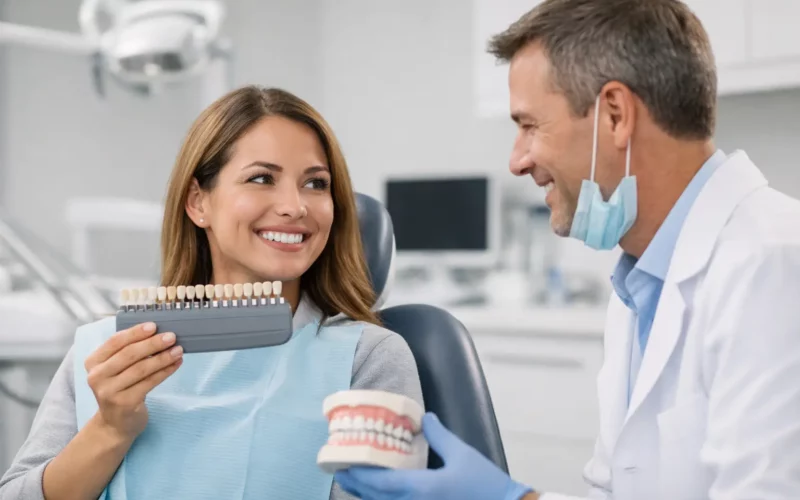
A consultation is essential to receive a correct recommendation and a tailored plan. In a modern clinic, the patient should clearly understand what is being done, why it is being done, how long it takes, and what realistic result can be achieved.
Who is dental aesthetics for
Dental aesthetics is suitable for patients who want to correct the appearance of their smile, as well as those who need dental restorations that blend in naturally. It can be a great choice if you avoid smiling in photos, cover your mouth when you speak, or feel that the appearance of your teeth does not reflect how you want to present yourself.
However, there are situations where treatment must be postponed or staged. If there is gum inflammation, multiple cavities, dental infections, or bite problems, these must be treated first. Dental aesthetics works best when it has a healthy foundation.
For patients in Satu Mare looking for modern solutions, the difference lies in a comprehensive approach. It is not just about what you see in the mirror, but also about how well the result lasts over time.
What to look for before starting cosmetic dental treatment
Before making any decisions, it is worth considering a few simple things. Your dentist should explain your options clearly, without making unrealistic promises. A treatment plan must prioritize the health of your teeth and gums, not just their appearance. Furthermore, the final result should be in harmony with your facial features and age, rather than being a copy of a standard model.
The technology used, the precision of the work, and the quality of the materials matter a great deal. In cosmetic dentistry, a beautiful result in the first week is not enough. What matters is that it still looks good months or years later, remains comfortable, and is easy to maintain through proper hygiene and regular check-ups.
At Art Dental Studio, treatment plans are built with attention to detail so that the final result is not only aesthetic but also functional and predictable. If you are wondering what cosmetic dentistry means for your specific case, the best step is a simple one: schedule a consultation to find out which option is truly right for you.
A successful smile shouldn't look "done"; it should look like your own, just more balanced, healthier, and more confident.