What is dental prosthetics and when do you need it

A cracked tooth, a missing molar, or an old restoration that no longer fits well can change more than just the appearance of your smile. If you are wondering what dental prosthetics are, the simple answer is this: it is the branch of dentistry that reconstructs damaged teeth or replaces missing ones, so you can chew, speak, and smile with confidence again.
For many patients, dental prosthetics is the stage where treatment becomes visible. The pain has been resolved, the infection treated, the implant placed, or the tooth prepared, and now comes the phase that restores form, function, and aesthetics. That is precisely why choosing the right solution matters both medically and aesthetically.
What exactly is dental prosthetics?
Dental prosthetics focuses on restoring damaged teeth and replacing lost ones with custom-made restorations. These can be fixed, such as crowns, bridges, or implant-supported prostheses, or removable, such as certain types of dentures.
The goal is not just to look good. A well-made prosthetic restoration must restore bite balance, protect remaining teeth, allow for proper hygiene, and provide comfort in daily use. In other words, dental prosthetics is not just about "putting in a tooth," but about correctly rebuilding the entire function of the treated area.
When is dental prosthetics recommended?
Dental prosthetics is indicated in several common situations. It may be necessary when a tooth is severely affected by decay and can no longer be reconstructed simply with a filling. It is also recommended after root canal treatments, especially if the tooth has lost significant tooth structure and is at risk of fracturing.
Prosthetics also become essential when one or more teeth are missing. A gap never remains without consequences. Adjacent teeth can shift, the opposing tooth can migrate, and the bite gradually changes. Sometimes this leads to chewing pain, other times to speech difficulties or aesthetic discomfort.
In complex cases, prosthetics are part of full-mouth rehabilitations, where multiple areas of the dentition are reconstructed to achieve a stable, functional, and harmonious result.
Types of prosthetic restorations
Dental crowns
A dental crown covers a damaged tooth and protects it long-term. It is one of the most common prosthetic solutions and is recommended when a tooth is weakened, cracked, root-canal treated, or extensively restored.
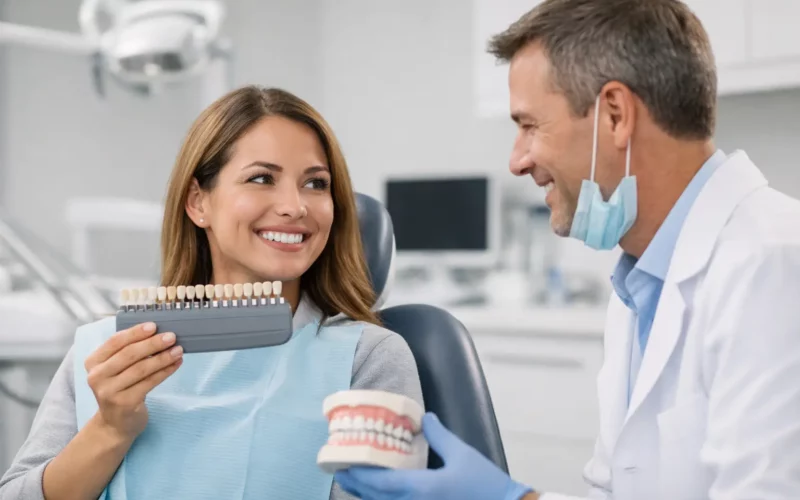
A well-fitted crown must blend naturally into your smile and withstand chewing forces. The material chosen matters, as it influences both aesthetics and durability. In visible areas, patients typically prefer all-ceramic or zirconia materials due to their appearance, which closely resembles that of a natural tooth.
Dental bridges
A dental bridge replaces one or more missing teeth by anchoring to adjacent teeth or implants. It is a fixed, stable, and efficient solution in certain cases.
However, it is not suitable for every situation. If the adjacent teeth are healthy, the dentist may recommend a more conservative alternative, such as a dental implant. The choice depends on bone condition, overall oral health, the number of missing teeth, and long-term goals.
Dentures
Dentures can be partial or complete, removable, or implant-supported. They are indicated when multiple teeth are missing or when the dentition can no longer be maintained in a functional state.
Many patients associate dentures with discomfort, but current technology allows for much more precise and aesthetic solutions than in the past. The major difference lies in planning, material quality, and how the restoration is tailored to each patient's specific needs.
Implant-supported restorations
When a tooth is completely missing, a dental implant provides the foundation for a crown, a bridge, or even an extensive restoration. From a prosthetic standpoint, this is one of the most modern and stable options available.
The main advantage is that the restoration is supported by the implant rather than adjacent teeth. This helps preserve healthy tooth structures and provides a sensation close to that of a natural tooth. For many patients, it is the solution that best combines function, stability, and aesthetics.
How the prosthetic treatment process works
Treatment always begins with a clinical and radiological evaluation. The dentist analyzes the condition of the teeth, gums, bone, and bite. The goal is not just to choose a restoration that "fits" the space, but one that functions correctly within the entire dentition.
After the treatment plan is established, the area is prepared. Sometimes this requires treating cavities, professional cleaning, endodontic treatment, or the extraction of a non-restorable tooth. In other cases, the implant is inserted, followed by a period for osseointegration.
The next stage involves taking a traditional or digital impression, depending on the available technology, followed by the fabrication of the prosthetic restoration. The dentist checks the shape, color, contact points between teeth, and how the restoration performs during chewing. Fine adjustments are important because a beautiful restoration that is uncomfortable is not a successful result.
How long it takes and what determines treatment time
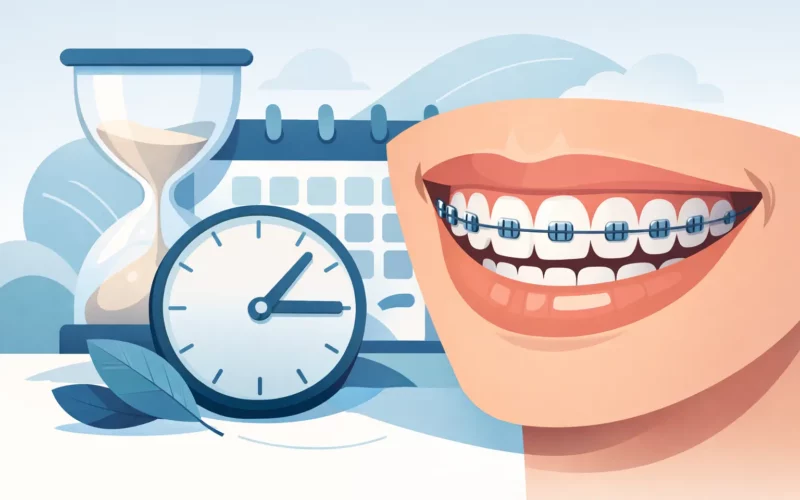
The duration varies from case to case. A dental crown can be made relatively quickly, while a full-mouth rehabilitation on implants requires several stages and a longer period.
It depends on the complexity of the case, the type of restoration, the condition of the gums, the need for preliminary treatments, and the biological healing time. That is why the correct answer is not "this is how long it takes for everyone," but "it depends on your clinical situation." An accurate assessment is the only way to provide a realistic timeline.
How much does dental prosthetics cost
The cost varies depending on the type of restoration, the materials used, the number of teeth involved, and the complexity of the case. A crown has a different cost than a bridge, and an implant-supported restoration involves different stages and materials.
Patients naturally ask about price, but it is useful to also view treatment through the lens of durability, comfort, and aesthetic results. A well-planned and well-executed prosthetic restoration reduces the risk of re-intervention and provides a better long-term experience.
At a modern clinic, the treatment plan is clearly explained before starting, so you know what options you have, what each entails, and which version is right for your needs.
What are the benefits of dental prosthetics
The first benefit is functional. You can chew better, without avoiding certain foods and without overloading one side of your mouth. The second is aesthetic. Properly restored teeth change your smile, facial expression, and confidence in everyday interactions.
There is also a less visible but very important benefit: long-term dental stability. When gaps are closed correctly and the bite is balanced, the risk of tooth shifting, uneven wear, and overloading decreases.
What you need to know before choosing a prosthetic restoration
Not every solution that is good for another patient is automatically good for you. Sometimes the priority is aesthetics in the front area. Other times, strength in a high-pressure chewing area matters more. There are situations where an implant is the best option and situations where another alternative is more suitable.
That is why proper planning makes the difference. The dentist must consider not just the tooth or the missing space, but the entire relationship between the teeth, gums, bone, and the physiognomy of the smile. This is where you see the difference between a restoration that just solves a problem for the moment and one that offers stable, natural results.
How to maintain the results
A prosthetic restoration does not replace oral hygiene. On the contrary, it needs careful care to last well over time. Proper brushing, regular check-ups, and professional cleanings remain essential.
Furthermore, if you grind your teeth, have a habit of chewing on hard objects, or delay your check-ups, the restoration may wear out faster or cause complications for the surrounding teeth and gums. Maintenance is not complicated, but it must be done consistently.
For patients seeking modern dental restoration solutions, dental prosthetics means much more than a final stage of treatment. It is the component that restores the shape, function, and natural appearance of your smile when done correctly, with careful planning and quality materials. If you have damaged teeth, missing spaces, or old restorations that no longer satisfy you, schedule an evaluation and find out which option is truly right for you.