Dental implant or bridge – what should you choose?

When you lose a tooth, the question isn't just how to replace it, but how to do it right for the years to come. For many patients, the choice between a dental implant or a bridge comes up quickly during the first consultation, especially when they want a solution that looks good, is stable, and won't complicate their life in the long run.
Both options can restore your smile and chewing ability, but they are not equivalent. The differences depend on the treatment method, the condition of the adjacent teeth, the available bone, the time required, and, of course, the budget. That is precisely why the right choice isn't made after reading a price or hearing a general recommendation, but after understanding what you gain and what you compromise with each option.
Dental implant or bridge – what is the real difference?
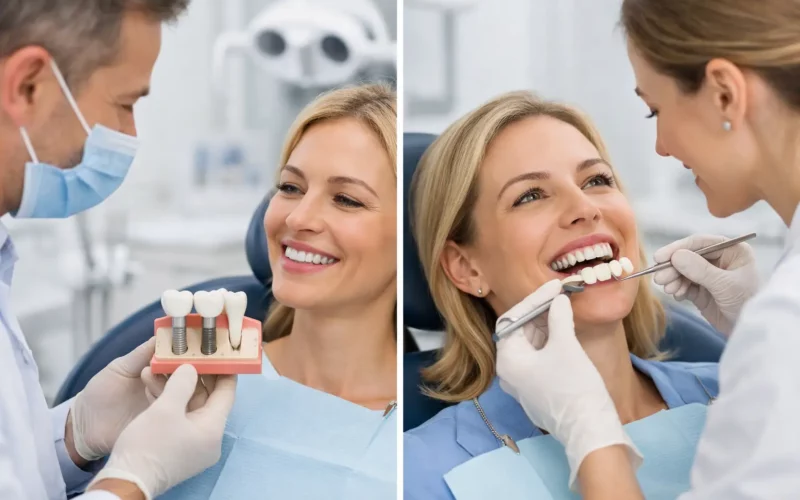
A dental implant replaces the root of the missing tooth with a biocompatible screw inserted into the bone, over which a crown is later fixed. Essentially, the missing tooth is restored independently, without needing to rely on neighboring teeth.
A dental bridge replaces the missing tooth by using the adjacent teeth as anchors. These teeth are prepared, usually by grinding, and then support a fixed restoration consisting of connected crowns.
In short, the implant reconstructs the missing space from the base, while the bridge covers it by using the support provided by the surrounding teeth. This is where almost all the important differences stem from.
When is a dental implant more suitable?
The implant is often the first option recommended when the patient has sufficient bone, good oral health, and wants a solution as close as possible to a natural tooth. The great advantage is the preservation of neighboring teeth. If they are healthy, they do not need to be sacrificed to support the restoration.
Another major benefit is bone maintenance. After losing a tooth, the bone in that area gradually begins to resorb. The implant helps stimulate the bone and can limit this loss, which matters not only for function but also for the aesthetics of the gums and face.
For many patients, stability is the deciding factor. A well-integrated implant offers the feeling of a fixed, solid restoration that allows for efficient chewing and comfort in speech. Aesthetically, the result can be very natural when the treatment plan is done correctly.
However, there are conditions. The implant requires careful evaluation, sometimes imaging investigations, and in certain cases, additional procedures such as bone grafting or treatment of gum disease before insertion. Also, the treatment takes longer than in the case of a bridge, because the implant needs time to integrate into the bone.
When can a dental bridge be a good choice?
A dental bridge remains a valuable solution in certain clinical situations. If the adjacent teeth already have large fillings, old crowns, or are otherwise compromised and require prosthetic coverage anyway, a bridge can provide a good result without feeling like a compromise.
It is usually a faster option. In many cases, after preparing the abutment teeth and taking impressions, the final restoration can be fitted in less time than implant treatment. For patients seeking a quick resolution or those who are not candidates for implants due to insufficient bone or other local factors, a bridge can be very useful.
However, the biological cost of this option must be clearly understood. If the adjacent teeth are perfectly healthy, grinding them down to support a bridge means intervening on structures that could otherwise remain intact. Furthermore, the area beneath the bridge pontic requires careful cleaning with specialized tools to prevent gingival inflammation and plaque buildup.
Dental implant vs. bridge: duration and stages
If you look strictly at the time until the final restoration, a bridge often seems simpler. Depending on the case, it can be completed in a few appointments over one to two weeks, or slightly longer, depending on the complexity and the laboratory.
A dental implant usually involves several stages. There is the consultation and treatment plan, the implant insertion, the healing period, and then the placement of the crown. In some cases, immediate loading is possible, but this is not an option for every patient. When the bone or gum requires additional preparation, the total duration increases.
This does not mean that a bridge is automatically better because it is faster. In dentistry, speed should not be the only criterion. A slower, yet more conservative and long-term stable solution may be more suitable for an active patient who wants predictability and comfort for many years to come.
Costs: what you pay now and what matters later
One of the most frequent questions is related to cost. In general, the initial cost of a dental bridge can be lower than that of a complete dental implant, especially if we are looking at a single missing tooth. This is why many patients consider it from the start.
An implant involves several components and stages—the surgery, the implant itself, the abutment, and the crown. That is why the initial investment is usually higher. However, a fair comparison is not based solely on the upfront sum.
One must also consider how things evolve over time. If a bridge overloads or compromises the abutment teeth, subsequent costs can rise. If problems arise under the restoration or at the gum level, treatment becomes more complex. With an implant, proper maintenance and regular check-ups are essential, but the advantage is that the adjacent teeth remain independent.
That is why the honest answer is this: the cheaper option at the beginning is not always the most advantageous option in the long run.
Aesthetics and comfort in everyday life
Both implants and bridges can provide excellent aesthetic results when planned correctly. The difference is seen primarily in how the restoration behaves over time and in its relationship with the gum.
An implant generally offers a sensation closer to that of a natural tooth because each unit is treated separately. Cleaning is more intuitive, and the patient no longer feels like they have a tooth suspended between two pillars. In the front area, planning must be very precise so that the gingival profile and the shape of the crown look natural.
A dental bridge can look great, especially when crafted using modern techniques and premium materials. However, cleaning it can be more challenging. Patients must carefully clean underneath the restoration, which requires discipline. If oral hygiene is poor, the gums may react.
What influences the final decision
There is no one-size-fits-all answer to the dental implant versus bridge question. However, there are several clear criteria that help guide the right decision.
The condition of the adjacent teeth matters. If they are healthy, an implant has a clear advantage. The available bone and the state of the gums are also important. Other factors include the position of the missing tooth, your bite, whether you grind your teeth, how quickly you want results, and how diligent you can be with your oral hygiene.
The case history also plays a role. If the tooth was extracted recently, the options may differ from a situation where the gap has existed for many years. In some cases, the ideal treatment may require preparatory steps before choosing the final solution.
At a modern clinic, decisions are not made by guesswork, but based on a comprehensive evaluation. This provides security and reduces the risk of choosing a restoration that seems convenient now but creates difficulties later.
When you shouldn't delay replacing a missing tooth
Many patients get used to the gap and postpone treatment for months or even years. The problem is that adjacent teeth can shift, your bite can change, and the bone can progressively resorb. The more time that passes, the more complex the treatment may become.
Replacing a missing tooth is not just about aesthetics. It is about the balance of your entire dentition, proper chewing function, and preventing further issues. If you are wondering which option is right for you, the best step is not to choose between an implant and a bridge on your own, but to find out what is recommended for your specific case.
At Art Dental Studio, the treatment plan is determined based on your oral health, your goals, and long-term outcomes. If you have lost a tooth and want a safe, aesthetic solution tailored to your needs, schedule a consultation. A good decision always begins with an accurate diagnosis.