Dental implants for total tooth loss

When you no longer have any teeth on one or both arches, the problem is not just aesthetic. Chewing becomes difficult, speech can be affected, and removable dentures do not always provide the desired stability. In these situations, dental implants for total tooth loss represent one of the most modern and predictable solutions to regain comfort, function, and confidence in your smile.
For many patients, the question is not whether treatment exists, but which option is truly right for them. The answer depends on the available bone, the general condition of the oral cavity, aesthetic expectations, and budget. That is why a proper plan always begins with a careful evaluation, not a one-size-fits-all solution.
What total tooth loss means and why it matters
Total tooth loss occurs when all teeth on the upper jaw, lower jaw, or both arches are missing. Sometimes this is due to teeth lost over time, while other times it involves remaining teeth that are unrestorable and must be extracted before rehabilitation.
Beyond the visible appearance, changes occur that affect daily life. The bone begins to resorb, cheeks may appear sunken, and diet becomes limited. Furthermore, many patients avoid smiling or speaking freely in public, especially if their dentures shift.
This is where the major difference offered by implantscomes in. They replace the roots of missing teeth and create a stable foundation for a fixed bridge or a more securely anchored denture.
Dental implants for total tooth loss – what options are available
There is no single formula that fits every patient. In modern practice, the most common options are fixed bridges supported by multiple implants and implant-stabilized dentures.
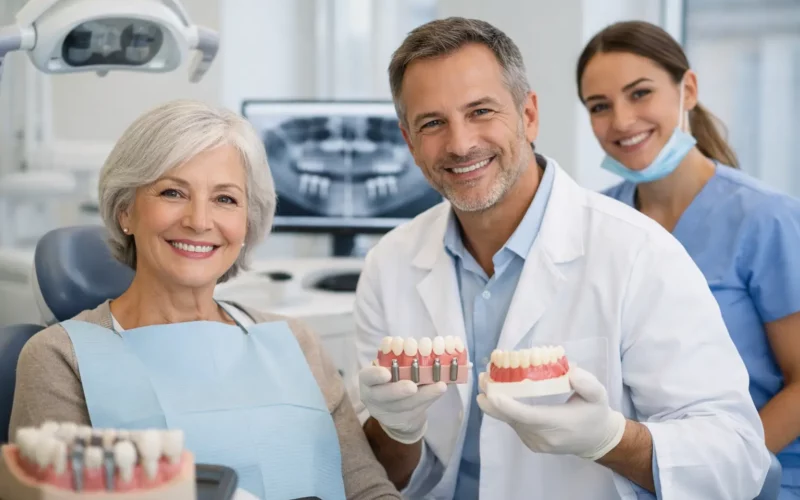
A fixed bridge is the preferred option for patients who want a sensation closest to natural teeth. It is supported by a number of implants determined by the anatomy of each case and provides excellent stability for chewing and speaking. For many patients, this is the treatment that most significantly improves quality of life.
Implant-supported dentures can be a good alternative when bone conditions or budget suggest a different solution. Compared to a traditional denture, this is much more stable and comfortable. It does not offer the exact same experience as a fixed bridge, but for certain situations, it can be a very good compromise.
In certain cases, immediate loading can be performed, meaning the implants are inserted and a fixed temporary bridge is applied in a short time. However, not every patient is a candidate. The initial stability of the implants, bone quality, and the presence of local infections are critical factors.
Fixed bridge on implants
This option is frequently recommended for patients who want to avoid removable dentures. The bridge remains fixed to the implants and offers a high level of comfort. Aesthetics are also a major advantage, especially when planning is done correctly, taking into account facial shape, lip support, and bite.
Implant-supported denture
This is a practical option for patients who need more stability than a traditional denture offers, but are not ideal candidates for extensive fixed rehabilitation. It is easier to remove for cleaning, and the cost can be more accessible. The limitation is that the wearing experience is not identical to that of a fully fixed restoration.
How to determine if you are a candidate for treatment
The first step is the consultation, followed by imaging investigations and a careful analysis of the bone. The doctor checks the height and thickness of the bone, the position of anatomical structures, and the condition of the gums. If there are compromised teeth, infections, or old, non-functional restorations, these are integrated into the treatment plan.
An important aspect is bone resorption. The longer teeth have been missing, the more the bone may have diminished. This does not automatically mean that implants are not possible, but it may change the strategy. Sometimes bone grafting is needed, while other times a different distribution of implants can be chosen.
Patient habits also matter. Bruxism, smoking, and poor oral hygiene can influence the prognosis. These are not always absolute contraindications, but they require more careful planning and genuine cooperation from the patient.
Treatment stages for total tooth loss
Patients naturally ask how long it takes and what they will actually go through. The duration depends on the complexity of the case, but the general path is clear.
Everything begins with the consultation and the personalized plan. This is where options, costs, the desired result, and the estimated time are discussed. If there are teeth that can no longer be saved, extractions are planned. In the same stage, it is analyzed whether a fixed temporary solution is possible or if an intermediate stage is needed.
Next is the insertion of the implants. The procedure is performed in a controlled manner, with an emphasis on precision and correct positioning. After insertion, the implants need a period of osseointegration, meaning integration into the bone. In some cases, a temporary restoration can be applied quickly; in others, it is safer to wait for healing.
After the implants have integrated, the prosthetic stage begins. The necessary impressions or scans are taken, the shape and bite are tested, and then the final restoration is created. A well-done treatment means not only correctly inserted implants but also a balanced, comfortable, and aesthetic restoration.
How long recovery takes
Immediate recovery after implant insertion is usually easier to manage than many patients imagine. There may be moderate swelling, sensitivity, and temporary discomfort, but these are manageable through the post-treatment instructions provided.
Adapting to the new restoration also takes time. Even if the result is stable, the muscles and speech need a short period of adjustment. For patients who have worn removable dentures for a long time, the difference in comfort is usually evident from the very first days.
Complete healing and long-term success depend on following up with check-ups and maintaining hygiene. Implants do not get cavities, but the tissues around them must be kept healthy.
How much do dental implants for total tooth loss cost
Cost is one of the first questions, and rightly so. Full-mouth rehabilitation involves several components: consultations, diagnostic tests, potential extractions, implants, prosthetic parts, temporary restorations, and the final work. That is why the price varies significantly from one case to another.
The number of implants influences the cost, but it is not the only factor. The type of final restoration, the need for bone grafting, and the functional and aesthetic complexity all change the overall treatment plan. For this reason, a generic price quoted without an evaluation does not truly help the patient.
The right approach is to receive a clear, step-by-step plan with explanations of what each phase includes. This allows you to realistically compare not just the final sum, but also the value of the treatment, the materials used, the technology involved, and the predictability of the result.
What results you can realistically expect
Implant treatment for total tooth loss can offer a major transformation. Patients primarily notice more confident chewing, clearer speech, and stability that is far superior to removable dentures. Facial aesthetics can also improve by restoring lip support and smile proportions.
However, results must be viewed realistically. Not all cases allow for the same solution, and sometimes anatomy requires controlled compromises. A patient with advanced bone resorption may need a different plan than someone who has recently lost their teeth. This is precisely why clinical experience and personalized planning matter so much.
Why the clinic and technology used matter
In full-mouth rehabilitations, the difference is not just the implant itself, but the entire process. Precise diagnostics, digital planning, premium materials, and close collaboration between the doctor and the laboratory contribute directly to the outcome.
For patients in Satu Mare and surrounding areas, choosing a clinic that frequently treats such cases means greater peace of mind and clearer communication throughout the treatment. At Art Dental Studio, the focus is on comprehensive solutions, modern technology, and results that must be not only aesthetic but also stable over time.
If you are facing total tooth loss, do not delay your evaluation for fear that the situation is too complicated. Often, the very cases that seem hopeless just need a well-crafted plan. Schedule an appointment to find out which option suits you, because a fixed, functional smile may be closer than you think.